Author Archive

Bibliography

Comentaris

Conclusion

Bearing in mind all the concepts we have analyzed, we can achive the following conclusions: we are in front of a genius: Shakespeare. He is able to write lots of different comedies, some of them similar but never the same. All of his characters are different people, and he can reach these different personalities through their speeches. He dominates the written language and makes the spectator not only identify himself with the characters but also, Shakespeare manages him to take part in the play.
 
The topics he deals with in the comedies are not so far from nowadays. It is said that Shakespeare anticipated Freud’s theory. The psychoanalysis is very realted not only to his tragedies but also to his comedies. The illusions, dreams, jokes and misunderstandings caused by the mistaken identities are a way of reveal the unconscious, the knowledge and the ignorance.
 
Maybe we could say that as time goes on, Shakespeare’s comedies go more complex in a way. Without despising his earliest works, we have proved that one of his earliest plays The Comedy of Errors, which is one of Shakespeare’s farcical comedies, seems to deal with humorous topics. However, we observe that in Much Ado About Nothing and in The Taming of the Shrew, there is a more complex struture in the plot, and we can also find some subplots. It is as if the latest comedies had much more strenght than the earliest ones.
 
We can make a very obvious paralellism between female characters, in which we observe this grip. Adriana, Beatrice and Katherina, the three of them represents the same profile of woman: confident, independent… But the three are different from each other. Perhaps, we could say that their power increase with the last comedies, because Beatrice seems more powerful than Adriana, and Katherina is the most powerful of the three, in terms of rage, strength, fighting spirit, belligerence.
 
To sum up, we could conclude that we observe in this specific case an evolution of his comedies and therefore in his characters, but this doesn’t mean that the earliest ones are worthless.

Back


Comentaris

Development of the topic

To start with, we should have in mind a clear idea about each comedy. So in order to know that, I will briefly explain the plot of each comedy so that you will understand better the analysis and comparison of the characters.

The Comedy of Errors

So, I will start with The Comedy of Errors, which is one of his earliest comedies. It is said to be the shortest play in Shakespeare. It consists in a humorous and farcical plot caused by mistaken identities. We can find an online version in youtube, which sticks to the original text. Also we can see it while reading the written version in this website, in which you can find everything about Shakespeare.

The Comedy of Errors is the story about two couples of twins that were separated at birth, so when they grow up, they didn’t know anything about the other’s existence. When Antipholus of Syracuse and his servant, Dromio of Syracuse arrive to Ephesus, where the two other twins live, it starts to happen a lot of confussion because of mistaken identities. They are even accused of madness and demonic possession. Finally, they all meet at the same time and realize that there are two couples of twins. And also, both Antipholus met up with his father. So, the order in restablished and we have a happy ending.

Regarding the characters, we could start with the two couple of twins in which, both Antipholus are the masters, and both Dromio are the servants. While the master plays jokes on Dromio and blame him about all misunderstandings, overcoat Antipholus of Ephesus with Dromio of Ephesus, Dromio plays the role of the jester or the fool, although he is indulgent and manageable.

Then, Adriana, who is Antipholus of Ephesus’ wife, plays the role of a strong woman, who likes having the power. She complains about his husband’s attitude, although it is one the misunderstandings, because he is not his real husband, he is Antipholus of Syracuse. She is not submissive as Luciana, her sister. This one is a good-natured person, and very understanding. We could say that between both, Adriana is the one with the strongest character while Luciana is the one with the weakest one.

Much Ado About Nothing

Moving on to the comedy of Shakespeare’s middle period, Much Ado About Nothing, as we explained in the first paper, it is about a two pairs of lovers, Beatrice and Benedick, and Hero and Caudio. The first cuople don’t want to recognise their love at first, but then when overhearing a someone else’s conversation, they show each other their love. While the other love story is a little bit different, because they are committed from the beggining but when Claudio misunderstands a possible Hero’s infidelity, he rejects her at the altar. But finally, they came up with the truth and we have two happy endings.

As we analized in the first paper, the strongest character is Beatrice, because she is a woman with a philosophy well ahead of its time. She doesn’t want to marry, although she ends up marrying. On the other hand, the character of Hero is a very weak person and possibly because of she is still very young, we don’t see her with very clear ideas, as Beatrice.

The Taming of the Shrew

Finally, one of Shakespeare’s last comedies, The Taming of the Shrew, deals about a woman called Katherina, who has a very strong character; she is a rebel of the time, and doesn’t want to marry a man, as it was the usual of girls at her age. However, she marries Petruchio, a gentleman of Verona. At the beggining she continues behaving as a shrew, and she is always arguing with him. Maybe, the first time he calls her Kate, instead of Katherina, when they hadn’t yet married, is when he starts taming her, and «steals» her personality calling her Kate. But we won’t see this huge change until the moment they decide to visit her father. This is when she starts behaving as a submissive wife, and obeys all his rules.

In the subplot we see her sister, Bianca, who is a woman with a more affable character, and also very desired by men. She can be considered as a naive woman, and that’s why she allows to be desired by Lucentio and elopes with him.

It has been a very controversial play because it has a lot of misogynous elements. But in my opinion, is one of his most interesting plays, because none is indifferent to it. It kept me thinking about why does she changes her attitude so much. She is supposed to be a rebel, someone who doesn’t soften to anyone, but at the end she becomes the most submissive wife, the one who allows everything to her husband, and always obey him, because it is her task as a good wife. This huge change is confusing to me.

Comparison & analysis

I found a very interesting book about Shakespearean comedies and how they are relate to psychoanalysis, so I selected the parts in which the author talks about the topic we are dealing with in this paper. The book is called: Staging the Gaze. Postmodernism, Psychoanalysis, and Shakespearean Comedy. And it is written by Barbara Freedman.

«Shakespearean comedies are concerned with dislocating perspective; they suggest that only a limited perspectival space defined by error constitutes identity. A limited misrecognition occurs when the comedies thematize these pshysical and visual errors to demonstrate how gender, class, and ideology function as sites of misrecognition. In The Comedy of Errors, Shakespeare adds to broad physical, visual comedy an interrogation of the very possibility of a discourse of mastery. In The Taming of the Shrew, Christopher Sly’s interpellation as a lord serves as model for coercive system known as class identity. The construction of Sly’s «madam wife,» who is actually a male servant disguised as a female, highlights the constrictive system of gender against which Kate rebels. The comedies encourage us to question not only the master-servant relationships within the plots but the realtions of power implicit in the conventions of «right spectatorship.» They no sooner create ambiguous subject positions for their characters that they refer the tension of mistaken indetification back to their viewers.

In question is how to read plays that stage reading as erring. Like the characters within The Comedy of Errors, readers of that play are torn between an interpretation of events based on an appealing fantasy of narrative closure and an interpretation that subverts the fantasy of a unified reading. (…)

Comedy claims as its province both the representation of illusion and the illusion of representation, both the forms of desire and the desire of form. Its divided voice allows it to comment on itself and so upon the structure and workings of the psyche as discourse. Its multiple perspectives enable it not only to interrupt its own construction but to stage that interruption in dizzying en abyme structures, in complex games of self-reference, and in paradoxical shifts in levels of representation. Shakespeare’s comedies work at the boundaries between what can and cannot be seen, known, or represented; in their concern with errors, dream, censorship, and illusion, they anticipate Freud’s study of considerations of representability. Like dreams and jokes, the comedies display unconscious discourse, stag the relationship between desire and sinification, and explore how the categories of knowledge and ingnorance are generated.»

(Introduction of the already named book)

«But we have yet fully to appreciate how the comedies’ game with a spectator consciousness offer a model of knowing unknowingness which requires us to rethinkthe reading process. Their notorious resistance to interpretation makes sense in the context of a rich cultural tradition of staging blindness and erring as a form of insight. Their interactive traps not only play upon our desire to see ourselves seeing but expose us as observed from a point of view within as well as from without with which we can never merge. Given their interest in a model of subjectivity which is not ego oriented but based on the inevitable play of blind spots and misrecognitions, given their concern with figuring how we cannot see and know as a form of positive knowledge, Shakespeare’s comedies suggest less a field on which to prove the truth of psychoanalysis than a means by which to rethink issues facing it today.»

(First chapter of the already named book)

Apart from this approach to the topic, I would also like to make my own comment on it. So, in this book it is very well explained how Shakespeare’s comedies are concerned with a huge amount of nowadays topics like the class, or the perspective in which we see a person. And also, we see that the characters are pretty much related with Freud’s psychoanalysis.

Apart from that, if we had to make a paralellism between comedies, we could go to the female characters of Much Ado About Nothing and The Taming of the Shrew, in which Beatrice and Katherina have a similar profile. Both are women with a philosophy well ahead of its time that rebels against society with their attitude, but contradictorially they both surrender to the will of a man. The female character on The Comedy of Errors that is most like them, is Adriana. Despite her case is not the same, we can find some similarities in the strong personality, and her desire of power.

Then, going on with the female characters, we could also find a similitude between Luciana, Hero and Bianca, who represent the role of the weak and submissive woman.

In a general view of the plays, it could be argued that in the earliest comedies Shakespeare made a more humorous plots to entertain the spectator, while in the middle and last comedies, he is more consistent in the topics, that’s to say, the plays seemed to me more serious and their plots and development are more complex, at least this is what I observe in this three comedies. While The Comedy of errors tells a humouristic story about misunderstanding; Much Ado About Nothing starts being more serious and we see a more complex characters’ minds, and finally in The Taming of the Shrew, Shakespeare shows us a conflict inside a woman’s mind, in which she changes through the play from «white to black.»

Back
 

Comentaris

Introduction

In this paper I will try to find out the differences between the first Shakespearean comedy, one of his middle period and one of his last comedies. I will try to do my best in finding the evolution his comedies suffered, how the characters are shown in each play, and the main features they have.

One of the things that makes big the figure of William Shakespeare, and his plays, are the characters. The way Shakespeare describes and makes them, enable the audience to apprepiate the plots. There are a huge variety of them, and each one is different in itself, which is one of the things that makes Shakespeare so especial. Not only that, but the fact that he achieved to create believeble characters is something to take into account. They are not estereotypes with exaggerated features or allegorical abstractions as we could find in many Elizabethan plays. They are instead men and women with the mingled qualities and many of the inconsistencies of life itself. They usually emerge in the play as extraordinary human beings (extraordinary in the sense of different fro the others).

The characters, as we said, are very varied. However, he could achieve the uniqueness of each one through their brilliantly individualized style of speech. We could say that Shakespeare was an expert in the human soul, and because of that, and added to the fact that he dominated the use of the language, he could write those dialogues that make his characters always intelligible, vital and memorable.

Back

Comentaris

Hero

She is the cousin of Beatrice. Although she is supposed to be the protagonist of the play, she speaks very few times along the whole play. She is characterized as an innocent young girl. Shakespeare draws her as a person who doesn’t take big decisions by herself, she expects somebody else to tell her what to do, which I supose that has something to do with the fact that she was a woman, and at that time, women were not suposed to have an opinion. So, they just want her to marry the prince and be happy.

For all those reasons, I think we are in front of a simple character, because she doesn’t show much of herself, just her sweetness and her imposibility of defending herself violently. Her character, therefore doesn’t suffer a development along the play. We could say that the same Hero that starts the play is the one who finishes it, without any big change in her. In the same line, it is the fact that she doesn’t show really her personality, we see her mind kind of opaque. We don’t see her beliefs, what she is thinking, it remains hidden.

All these contributes to make a very dificult task the fact of analyzing her from Freud’s perspective. There is no specific action that can be seen as something instinctive, o something that could follow the moral principle. Her action along the play doesn’t develop in these terms, so I found it impossible to take out a relevant fact that I could identify with id, ego or superego.

Comentaris

Claudio

He is a young Count from Florence, he is friend of Benedick and he will be the boyfriend of Hero. He falls in love with her the first time he saw her, although at that encounter she doesn’t speak a word. Along the play, he demonstrates a childish atitude towards the world, not only because of his actions but also because of his behaviour towards others.

Following the three Ewen’s axes, regarding to complexity of the character, I think that this is not something of extremes. In my opinion, we are not in front of a simple character, neither a complex one. So, comparing it with Beatrice and Hero for example, he would be in the middle. Beatrice is obviously much more complex than Claudio, and Hero is much simple than Claudio. Apart from his childish behaviour, he also shows that he has an impulsive personality and reacts with furious. His passionate feelings and enthusiams he shows, make him not that simple as Hero, although his inmaturity gives him away.

So, he could say that he suffers a kind of development along the play, because he is supposed to have learn something but actually we don’t have any clue of that. It’s not very clear his development as a character. And, in respects of pennetration into inner life, I think we observe his personality well enough, there isn’t anything he is hidding or something we can’t achieve from him.

Then, seeing him from Freud’s theories, I think that many of his acts can be seen overcoat that they are done from the id. For example we can analize the moment when he is asked to see the suposed infidelity of his future wife. He reacts with the instinct when he gets angry and then when he jilts her in the wedding, and tells everybody what he have seen the day before, that she have been unfaithful to him. This is a reaction that emerges from the inside of himself, he is angry and he shows it with no resctrictions.

But then, when he apologizes to Leonato’s, the father of Hero, because she has been killed, he demonstrates once again his inmaturity. He just says, «oh sorry, but in fact, it wasn’t my fault at all» and then he accepts to marry his other daughter, without knowing her,because he will do anything just to achieve Leonato’s forgiveness. Maybe this could be identified with the superego, talking about the morality principle, what people would think that is well-done or judging what it is not. So in order to gain Leonato’s forgiveness and everyone’s respect he would do whatever necessary.

Comentaris

Beatrice

Beatrice is a very important character in the play not only because of her love story but because of the role she plays. She is Hero’s cousin. She represents the image of a experienced woman-This character could be seen as the jester in the play, but, actually we shouldn’t see her as it, overcoat in extreme situations like the scene in which she asks Benedick to commit a crime.

We could compare her with a XXI century woman, who has her own ideas and beliefs. She has not that innocent spirit, as Hero has. Obviously she is older than Hero, but that doesn’t mean that a woman of her age would act like she does at her time. She is an independent woman who laughts at herself and take life with humour, that’s why sometimes its character could be confused with the jester.

According to Ewen’s classification of characters, we could say that Beatrice is a complex character, who has more than one trait. In fact, I would say that her character is the most complex of the play because she plays different roles along the play, I mean, she is not a flat and static character. Her personality is not dominated by one important trait, but by a lot of them. We see her humour, and her way she faces life. Then, we see her in a desperate situation, and she reacts according to it. And, we also see her happiness caused by loving a man.

Very related to this, is the fact that her character suffers a development along the play, when she is not interested in anyone, and even less in Benedick, but overhearing a conversation, she realises she loves him too. As I said, I think both concepts are related because if she would be a static character, the most evident would be not to develop, and viceversa.

In regards of the third axe of Ewen, penetration into inner life, I would say that Beatrice is a character that has nothing to hide. She shows herself the way she is, without any intrigues and later surprises. We could qualify her as a sincere and coherent person, and Shakespeare makes of her a character without any secrets or ambiguous things.

Then, taking into account what Freud says about the conscious and unconscious, I would try to identify some afirmative statements with the personality that Shakespeare has created for this character. I think, that Freud’s theory has not to be seen as a character in concrete, I mean that each point of the clasificantion could be identified with diferent actions of a character at some point. For example, in this case, Beatrice acts with what Freud would call the id, in the scene which asks Benedick to kill Claudio. It wouldn’t be, as Freud says, related to the pleasure principle as something sexual, but it has to do with our insctinct. She reacts in that way as a response to the attack that has suffered her cousin. So it is an instinctive reaction of defense.

Also, making a comparison with what Freud points out: «in popular language, we may say that the ego stands for reason and circumspection, while the id stands for the untamed passions.», we could affirm that her id says that she loves Benedick which is something from her unconscious, while her ego says the contrary, at the beggining of the play, when she rejects him.

Comentaris

Benedick

He is a young lord of Padua, and good friend of the Count Claudio. He has a weird personality, sometimes he does the role of being hateful and then, although he is always hiding it and speaking things against marriage, he is the eternal lover of Beatrice. He seems to be a bit dominant, or maybe egocentric, when he thinks that everything has to o with him. Sometimes he plays the role of the funny man, with which audience would have a good time. He is clever but he don’t look like that.

According to the three axes we could say that he is a complex character because he has a lot of traits that can define him. As the representation of a real person, he has his romantic aspect, his funny side, and so on. In the play we see an evolution on him, so he is a character who suffers a development, he develops as a person. He is not the same when the play starts that when it finishes. Along the play we see who he changes his mind in respects to marriage and love, when he shows his love to Beatrice. If we analize that moment, we can realize that he does not act like that just because he wants to seduce her, but because what of he has heard from the conversation of the men. He wants to prove that he is not scornful and proud. But then at the end, we see that his feelings are real, he loves her.

This character shows to the spectator the way he is. His mind doesn’t remind opaque as Ewen says. So, it’s personality is clear from the first moment.

Here, in this character we have many examples about what Freud would distinguish between id, ego and superego. For example, when Beatrice ask him to challenge Claudio, at the beggining he doubts, and that would be the part of the mind that Freud would call superego, because, as he says, it is the morality principle, and what she is asking for isn’t something very ethic. But then, in a moment, and for the love he feels for her, that he would do whatever in order to please her, he says he’ll do, so here, he acts with the id. He is reacting instinctively. He might think that once he is in love for Beatrice, his herarchy of loyalty has changed, and now the most important thing is she.

Comentaris

Freud’s theories

The foundation of Freud’s contribution to modern psychology is his emphasis on the unconscious aspects of the human psyche. A brilliant creative genius, Freud provided convincing evidence, through his many carefully recorded case studies, that most of our actions are motivated by psychological forces over which we have very limited control. He demonstrated that, like the iceberg, the human mind is structured so that its great weight and density lie beneath the surface (below the level of consciusness). In «The Anatomy of the Mental Personality, Lecture XXI,» in New Introductory Lectures on Psychoanalysis (New York: Nrothon, 1964), Freud discriminates between the levels of concious and unconcious mental activity:


The oldest and best meaning of the word «unconscious» is the descriptive one; we call «unconscious» any mental process the existence of which we are obligated to assume–because, for instance, we infer it in some way from its effects–but of which we are not directly aware… If we want to be more accurate, we should modify the statement by saying that we call a process «unconscious» when we have to assume that it was active at a certain time, although at that time we knew nothing about it. (99-100)

Freud further emphasizes the importance of the unconscious by pointing out that even the «most conscious processes are conscious for only a short period; quite soon they become latent, though they can easily become conscious again» (100). In view of this, Freud defines two kinds of unconscious:


one which is transformed into conscious material easily and under conditions which frequently arise, and another in the case of which such a transformation is difficult, can only come about with a considerable expenditure of energy, or may never occur at all… We call the unconscious which is only latent, and so can easily become conscious, the «preconscious,» and keep the name «unconscious» for the other. (101)
 
 
That most of the individual’s mental processes are unconscious is thus Freud’s first major premise. The second (which has been rejected by a great many professional psychologists, including some of Freud’s own disciplines–for example, Carl Gustav Jung and Alfred Adler) is that all human behaviour is motivated ultimately by what we would call sexuality. Freud designates the prime psychic force as libido, or sexual energy. His third major premise is that because of the powerful social taboos attached to certain sexual impulses, many of our desires and memories are repressed (that is, actively excluded from conscious awareness).


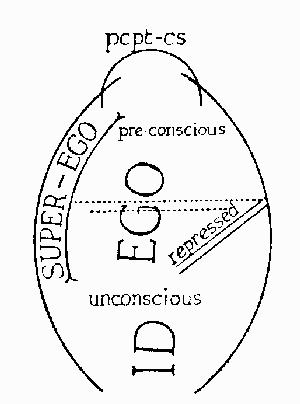
Starting from these three premises, we may examine several corollaries of Freudian theory. Principal among these is Freud’s assigment of the mental processes to three psychic zones: the id, the ego and the superego. An explanation of these zones may be illustrated with Freud’s own diagram:


The diagram reveals immediately the vast portion of the mental apparatus that is not conscious. Furthermore, it helps to clarify the relationship between ego, id and superego, as well as their collective realtionship to the conscious and the unconscious. We should note that the id is entirely unconscious and that only a small portion of the ego and the superego is conscious. With this diagram as a guide, we may define the nature and functions of the three psychic zones.

1. The id is the reservoir of libido, the primacy source of all psychic energy. It functions to fulfillthe primordial life principle, which Freud considers to be the pleasure principle. Without consciousness or semblance of rational order, the id is characterized by a tremendous and amorphous vitality. Speaking metaphorically, Freud explains this «obscure inaccessible part of our personality» as » a chaos, a cauldron of seething excitement [with] no organization and no unified will, only an impulsion to obtain satisfaction for the instinctual needs, in accrodance with the pleasure principle» (103-4). He further stresses that the «laws of logic– above all, the law of contradiction — do not hold for the processes of the id. Contradictory impulses exist side by side without neutralizing each other or drawing apart. Naturally, the id knows no values, no good and evil, no morality» (104-5).

The id is, in short, the source of all our aggressions and desires. It is lawless, asocial, and amoral. Its function is to gratify our instincts for pleasure without regard for social conventions, legal ethics, or moral restraint. Unchecked, it would lead us to any lengths- to destruction and even self-destruction– to satisfy its impulses for pleasure. Safety for the self and for others does not lie within the province os the id; its concern is purely for instinctual gratification, heedless of consequence. For centuries before Freud, this force was recognised in human nature but often attributed to supernatural and external rather than to natural and internal forces: the id as defined by Freud is identical in many respects to the Devil as defined by theologians. Thus there is a certain psychological validity in the old saying that a rambunctious child (whose id has not yet been brought under control by ego and superego) is «full of the devil.» We may also see in young children (and neurotic adults) certain uncontrolled impulses toward pleasure that often lead to excessive self-indulgence and even to self-injury.

2. In view of the id’s dangerous potentialities, it is necessary that other psychic agencies protect the individual and society. The first of these regulating agencies, that which protects the individual, is the ego. This is the rational governing agent of the psyche. Though the ego lacks the strong vitality of the id, it regulates the instinctual drives of the id so that they may be released in nondestructive behavioral patterns. And though a large portion of the ego in unconscious, the ego nevertheless comprises what we ordinary think of as the conscious mind. As Freud points out, «In popular language, we may say that the ego stands for reason and circumspection, while the id stands for the untamed passions.» Whereas the id is governed solely by the pleasure principle, the ego is governed by the reality principle. Consequently, the ego serves as intermediary between the world within and the world without.

3. The other regulating agent, that which primarily functions to protect society, is the superego. Largely unconscious, the superego is the moral censoring agency, the repository of conscience and pride. It is, as Freud says in «The Anatomy of the Mental Personality,» the «representative of all moral restrictions, the advocate of the impulse toward erfection, in short it is as much as we have been able to apprehend psychologically of what people call the ‘higher’ things in human life» (95). Acting either directly or through the ego, the superego serves to repress or inhibit the drives of the id, to block off and thrust back into the unconscious those impulses toward pleasure that society regards as unacceptable, such as overt aggression, sexual passions, and the Oedipal instinct. Freud attributes the development of the superego to the parental influence that manifests itself in terms of punishment for what society considers to be bad behaviour and reward for what society considers good behaviour. An overactive superego creates an unconscious sense of guilt (hence the familiar term guilt complex and the popular misconcetion that Freud advocate the relaxing of all moral inhibitions and social restraints). Whereas the id is dominated by the pleasure principle and the ego by the reality principle, the superego is dominated by the morality principle. We might say that the id would make us devils, that the superego would have us behave as angels (or, worse, as creatures of absolute social conformity), and that it remains for the ego to keep us healthy human beings by maintaining a balance that Freud advocated– not a complete removal og inhibiting factors.

Comentaris

Critical Approaches

When you analyze a play or a novel, you can follow different types of critical approaches. Among others, we find mainly the following:

  • The Formalistic Approach.
  • The Psychological Approach. (Freud)
  • Mythological and Archetypal Approaches.
  • Structuralist theories.
  • Poststructuralists theories
  • Marxist theories
  • Cultural Criticsm
  • Feminist theories

Comentaris

« Previous entries